What the Diagnostic Odyssey Actually Does to a Person (And What It Means for Therapy)
 Kanjana Hartshorne
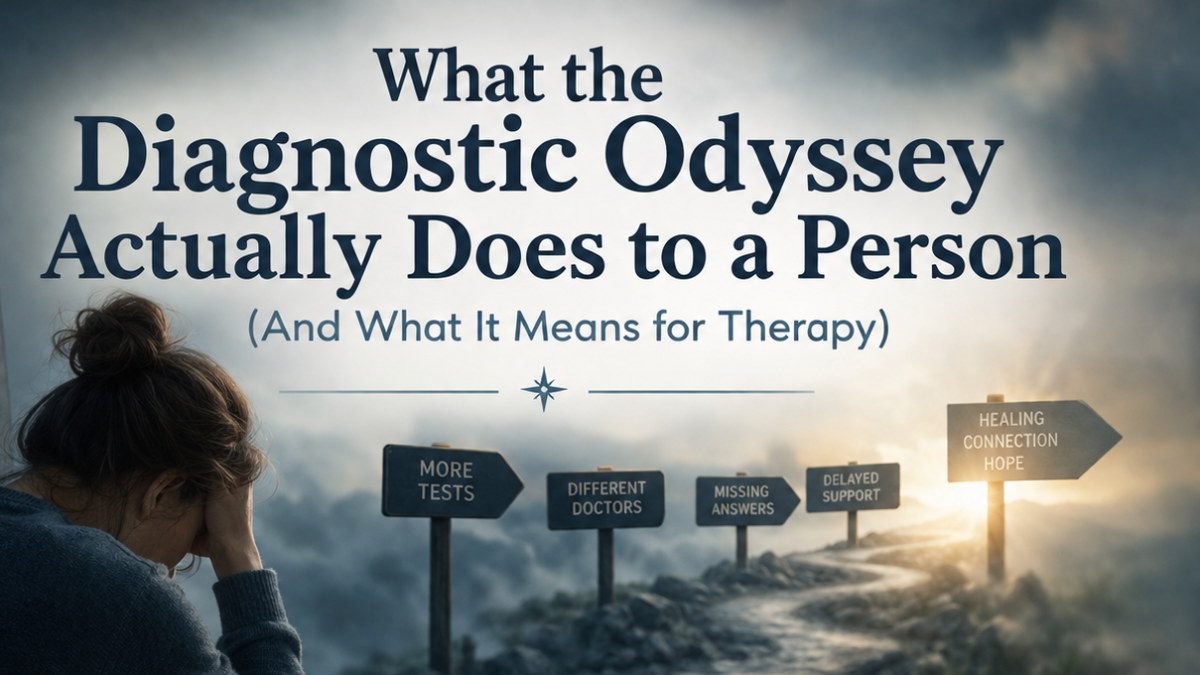
When we talk about medical trauma in clinical training, we usually focus on acute events.
There is a specific kind of trauma that happens in the waiting room.
When we talk about medical trauma in clinical training, we usually focus on acute events: a frightening diagnosis, an emergency procedure, a near-death experience. These are real and important. But for the growing number of clients presenting with complex, multi-system, or undiagnosed chronic illness, the trauma often looks very different. It is quieter, slower, and in many ways harder to name.
It is the trauma of the diagnostic odyssey.
The diagnostic odyssey is what happens when a person spends months or years seeking answers for symptoms that are real, debilitating, and consistently dismissed or misattributed. It is the experience of being passed from specialist to specialist, each one ruling out their particular domain and sending you on to the next. It is being told, repeatedly, that your labs are normal, that your symptoms are probably anxiety, that you should try losing weight or reducing stress or sleeping more.
For clients with conditions like hypermobile Ehlers-Danlos Syndrome, POTS, MCAS, fibromyalgia, Long COVID, or other complex presentations, this journey can take years. The average diagnostic delay for hEDS is over a decade. For fibromyalgia, it is often four to six years. These are not rare exceptions. They are the norm.
What prolonged dismissal actually does
Research on epistemic injustice helps us understand what happens when a person is systematically disbelieved about their own experience. Miranda Fricker's concept of "testimonial injustice" describes what happens when a person's credibility is unfairly diminished, and the research on chronic illness makes clear that this is not a theoretical concern. It is a daily reality for many of our clients.
When a person is repeatedly told that their lived experience is incorrect, they begin to doubt themselves. They start pre-editing their symptom reports before medical appointments, leaving out the things that sound too strange or too dramatic. They internalize the systemic doubt as a personal failing. They ask themselves: am I exaggerating? Am I just not handling this well? Is this really as bad as I think it is? I guess everyone feels this way?
This is not a cognitive distortion.
This is a rational adaptation to an environment that has consistently punished them for accurate self-reporting. It makes complete sense why someone’s self-trust would begin to erode.
And here is the clinical implication we cannot afford to miss: that erosion does not stay in the doctor's office. It walks into our therapy rooms right alongside our clients.
What this means for treatment engagement
Clients who have been through the diagnostic odyssey often present with patterns that can be misread as resistance, over-focus on symptoms, or even personality pathology. They may track their symptoms meticulously, which can look like health anxiety. They may be reluctant to try new interventions, which can look like passivity, resistance, or hopelessness. They may struggle to trust the therapeutic relationship, which can look like attachment difficulty.
Before we reach for those clinical frameworks, we need to ask: what has this person learned from their experience of seeking help? If every time they described their symptoms they were dismissed, it makes complete sense that they would be cautious about describing them again. If every intervention they tried failed to address the underlying problem, it makes complete sense that they would be skeptical of new ones.
These are not pathological responses. They are intelligent adaptations to a system that has repeatedly failed them.
What our role actually is
Our role is not to determine whether a client's symptoms are "real." That is not in our scope, at least not if you are a therapist like me. Our role is to be a consistent, believing, non-pathologizing presence while a client navigates a medical system that has often been anything but.
That means learning to hold uncertainty, without needing to fix it. It means resisting the pull toward premature reframing. It means understanding that grief and meaning-making can coexist, and that we do not need to rush clients toward acceptance before they are ready.
It can be really hard as a therapist. It can feel like sitting on your hands. Your own desire to fix and that feeling of urgency may challenge you. This is normal. It’s a skill you’ll learn with time.
Doing this work well also means examining our own biases. Who do we instinctively believe? Whose pain do we subtly question? Research is clear that women, people of color, fat clients, disabled clients, and clients with psychiatric histories face additional credibility burdens in medical settings. If we are not actively examining our own assumptions, we risk replicating those dynamics in the therapy room. Everyone has implicit biases, everyone. Be aware of yours.
I recently taught a comprehensive continuing education training on this topic for PESI, covering the diagnostic odyssey, the clinical patterns of complex chronic illness, how to counter self-blame and body mistrust, how to balance relational and solution-focused work, and the ethical considerations that come with this population. The recording is now available for CE credit.
Get the full PESI training recording here
Categories: : Wellness
Ready to Learn Differently?
Wanderhome offers experiential CE, retreats, and community for therapists
who want learning that lives in the body.
If this resonated, share it with a colleague who might need to hear it.